InviteBatch team
In this guide
- 1What is included in wedding stationery?
- 2What is a wedding invitation suite?
- 3What should be included in a wedding invitation?
- 4What goes on the RSVP card?
- 5What goes on a details card?
- 6How do you assemble a wedding invitation suite?
- 7What size is a wedding invitation suite?
- 8Which wedding stationery can you skip?
- 9How much does a wedding stationery suite cost?
- 10Paper, digital or both?
- 11How to make your whole suite in one go
- 12Wedding stationery checklist
The short answer: a wedding stationery suite is everything you send for the wedding, all in one matching design. The invitation suite in the envelope is the invitation, an RSVP card with its return envelope, an optional details card and the envelopes. Around it sit save the dates (sent first), on-the-day stationery (order of service, menus, place cards, table plan) and thank-you cards (sent after).
You don't need every piece. Most couples need five: save the date, invitation, RSVP, envelope and thank-you card. Below is the full checklist with what each piece is for, what goes on the invitation itself, standard sizes, the order to put it all in the envelope, and what you can safely skip to save money.
Get the whole suite with every guest's name
Invitations, RSVP cards with a personal QR code, a venue map card, envelopes, address labels and thank-you cards, all in one design, one per guest. $29.99 one-time for up to 1,000 guests. Preview free with your own list.
Choose a design →What's includedWhat is included in wedding stationery?
Wedding stationery falls into four groups, in the order your guests see them:
| Piece | What it does | Needed? | When it goes out |
|---|---|---|---|
| Save the date | Asks guests to keep the day free | Recommended | 6–8 months before (10–12 for a destination wedding) |
| Invitation | The formal invitation: who, when, where | Yes | 6–8 weeks before (about 3 months for a destination) |
| RSVP card | Collects replies, meal choices and dietary needs | Yes, or an online RSVP | With the invitation |
| Details card | Directions, parking, hotels, website, other events | Optional | With the invitation |
| Envelopes | Outer envelope, plus a return envelope for the RSVP | Yes for paper | With the invitation |
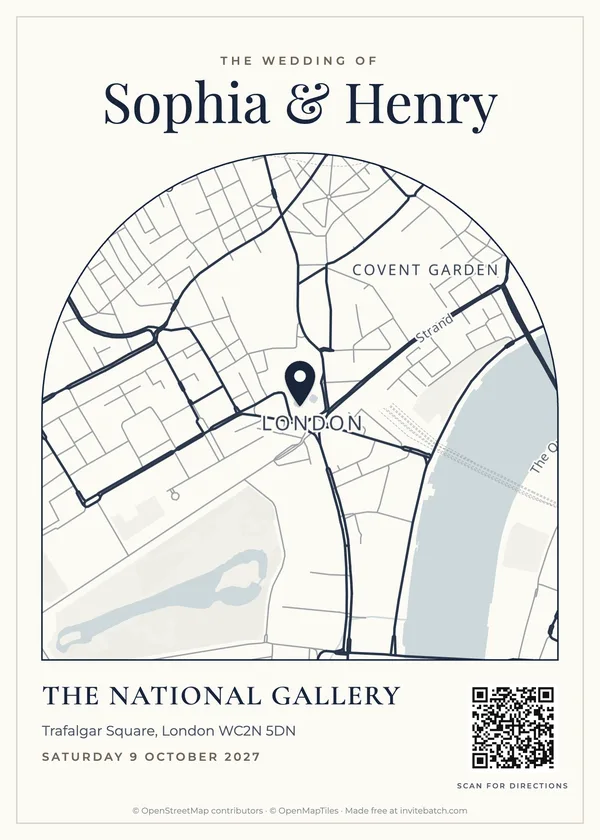
| Map card | Shows the venue, often with a QR code for directions | Optional | With the invitation |
| Order of service / programme | Running order of the ceremony | Optional | On the day |
| Menu, place cards, table numbers, seating chart | Help guests find their seat and see the meal | Optional | On the day |
| Welcome sign | Greets guests at the venue | Optional | On the day |
| Thank-you cards | Thank each guest for coming and for gifts | Yes | Within 3 months after |
The first group (save the dates) and the last (thank-you cards) are sent to every household. The middle groups depend on the size and style of the wedding.
What is a wedding invitation suite?
A wedding invitation suite is the set of matching pieces that go into one envelope: the main invitation, an RSVP card with its own small return envelope, and usually an enclosure such as a details card or a map. Everything shares the same design, fonts and colours, so it reads as one set.
A full stationery suite goes further and includes the save the date before and the thank-you cards after, in the same design. Matching everything from the first card to the last is what makes wedding stationery look planned rather than collected.
A pocket or belly band suite is the same set held together in a folder or with a paper band. It is a style choice, not an extra piece.
What should be included in a wedding invitation?
The invitation card itself carries the essentials, usually in this order:
- Host line: who is inviting. For example "Together with their families" or "Mr and Mrs David Carter request…".
- Request line: "request the pleasure of your company at the marriage of" (formal) or "invite you to celebrate their wedding" (modern).
- The couple's names: first and last names, the bride's name usually first in a traditional wedding.
- Date: written out in full on formal invitations ("Saturday, the twelfth of June, two thousand twenty-seven").
- Time: "at four o'clock in the afternoon" or "at 4 pm".
- Venue: the venue name and the town. A full street address can go on the details card.
- Reception line: "Dinner and dancing to follow", or the reception venue if it is somewhere else.
- RSVP line: the reply-by date and how to reply, if there is no separate RSVP card.
- Optional: dress code, "adults only", or the wedding website.
Keep anything that does not fit (hotels, parking, a second event, registry details) off the invitation and put it on a details card or a website. For complete wording you can copy, see wedding invitation wording examples, and for the guest's name on the card, how to write guest names on wedding invitations.
What goes on the RSVP card?
An RSVP card needs five things:
- A reply-by date, usually 3–4 weeks before the wedding
- A line for names, such as "M______" or the guest's printed name
- Accepts / declines tick boxes
- Meal choice and dietary needs, if the meal is served
- How to return it: a stamped, addressed return envelope, or a QR code to reply online
Online RSVPs have taken over much of this job. A QR code on a printed RSVP card lets guests reply from their phone, while you keep a live count instead of collecting cards. See wedding RSVP wording and when RSVPs should be due.
What goes on a details card?
A details card (also called an information or enclosure card) holds whatever does not fit on the invitation:
- Directions and parking, or a small map
- Hotels and room blocks
- Timings for other events, such as a welcome drink or a brunch the next day
- The wedding website and registry
- Transport between ceremony and reception
If most of your guests are local and you have a wedding website, you can skip the details card and print the website as a short line or a QR code. A map card is the one enclosure that still helps on paper, because guests use it on the day.
How do you assemble a wedding invitation suite?
Stack the pieces from largest to smallest, all facing up, so the guest sees the invitation first when they open the envelope:
- Invitation at the bottom (the largest card)
- Details card on top of it
- Map card, if you have one
- RSVP card, tucked under the flap of its stamped return envelope, or placed on top of it
- Slide the stack into the inner envelope (if you use one), then the outer envelope, with the front facing the back of the envelope
Weigh one finished envelope before buying stamps. A thick suite, a square envelope or a wax seal often needs extra postage.
What size is a wedding invitation suite?
Standard sizes keep envelopes cheap and post simple:
| Piece | US standard | UK common sizes | Envelope |
|---|---|---|---|
| Invitation | 5×7 in | 7×5 in, A5 or A6 | A7 (US), 5×7 or C6 (UK) |
| RSVP card | 4.25×5.5 in or 3.5×5 in | A6 or 6×4 in | A2 or 4-bar |
| Details card | 4×6 in or 3.5×5 in | 6×4 in or A6 | Goes in with the invitation |
| Save the date | 5×7 or 4×6 in | 7×5 or 6×4 in | Matches the size |
| Thank-you card | 4.25×5.5 in or 3.5×5 in folded | A6 or 6×4 in | A2 / C6 |
5×7 is the most common invitation size on both sides of the Atlantic and the cheapest to print and post. Square invitations look different but often cost more to post.
Which wedding stationery can you skip?
If you're on a budget, these are the pieces couples drop most often, and what to use instead:
- Details card: put the information on your wedding website and print the address or a QR code on the invitation.
- Paper RSVP card and return envelope: use an online RSVP. You save the card, the envelope and a second stamp per guest, and you get replies faster.
- Inner envelopes: a traditional extra layer, rarely missed.
- Printed save the dates: send them digitally, then save the paper for the invitation.
- Menus and place cards: one large menu board and a seating chart do the same job.
- Order of service: a single board at the ceremony, or none for a short civil ceremony.
The pieces worth keeping are the invitation (guests keep it), the thank-you card (expected) and, for a venue that's hard to find, the map.
How much does a wedding stationery suite cost?
It ranges from almost nothing to over a thousand:
- UK: Bridebook says UK couples spend an average of GB£378 on wedding stationery, from about GB£20 for a template to GB£1,500 for a bespoke set.
- US: Minted says its couples spend about US$480 on their wedding invitations.
- Per piece, foil and letterpress cost several times more than flat digital printing.
The biggest costs are the number of pieces per guest and the finish, not the design. Every extra enclosure multiplies across your whole guest list, and so does its postage. Counting by household rather than by guest keeps the numbers down. See how many wedding invitations to order.
Paper, digital or both?
| Paper suite | Digital suite | Mixed | |
|---|---|---|---|
| Best for | Formal weddings, keepsakes, older guests | Guests abroad, short notice, big lists | Most weddings |
| RSVP | Cards returned by post | Online, live totals | Online for everyone, QR code on paper |
| Cost grows with | Pieces, finish and postage | Usually nothing | Only the paper guests |
| Arrives | In days | Instantly | Both |
Many couples now print invitations for close family and send personal digital invitations to everyone else, with one RSVP list for both. A digital save the date on WhatsApp is the easiest place to start.
How to make your whole suite in one go
InviteBatch makes the matching suite from one design and one guest list, with each guest's name on their own pieces:
- Invitations with the guest's name, as print-ready PDFs (5×7, print sheets for US Letter and A4)
- RSVP cards with a personal QR code, plus an online RSVP per guest with meal choices and dietary needs
- A venue map card with a QR code for directions, in your invitation's colours
- Envelopes (A7) and address labels (Avery 5160 / L7160)
- Thank-you cards, personalised for every guest
- A personal invitation link for every guest, to send by WhatsApp, text or email
It costs $29.99 one-time for up to 1,000 guests, and you preview the whole thing free with your real list before paying. Want paper without printing it yourself? Upload any finished design and we print and post the cards, from $2.09 a card at 100 cards with envelopes, to the UK, US, Canada and 13 EU countries. For a fully digital wedding, the WhatsApp invitation website opens like an envelope with each guest's name, for $53.40 once.
What we don't make: order of service booklets, menus, place cards, table numbers and welcome signs. A local printer or a design app is the better choice for those.
See your suite with your guests' names in 2 minutes
Pick a design, paste your guest list and see every invitation, RSVP card and envelope before you pay. No account needed.
Start free preview →Print and post my cardsWedding stationery checklist
Tick these off in order:
- Guest list counted by household
- Save the dates sent (6–8 months before)
- Invitation wording written and checked by a second person
- RSVP date set (3–4 weeks before the wedding)
- Details: website, map, hotels decided
- Proof checked: names, date, day of the week, time, venue spelling
- One full envelope weighed for postage
- Invitations sent (6–8 weeks before)
- RSVP reminders sent one week before the deadline
- On-the-day pieces ordered (if any)
- Thank-you cards sent (within 3 months)
Timings for every kind of wedding are in when to send wedding invitations and when to send save the dates.